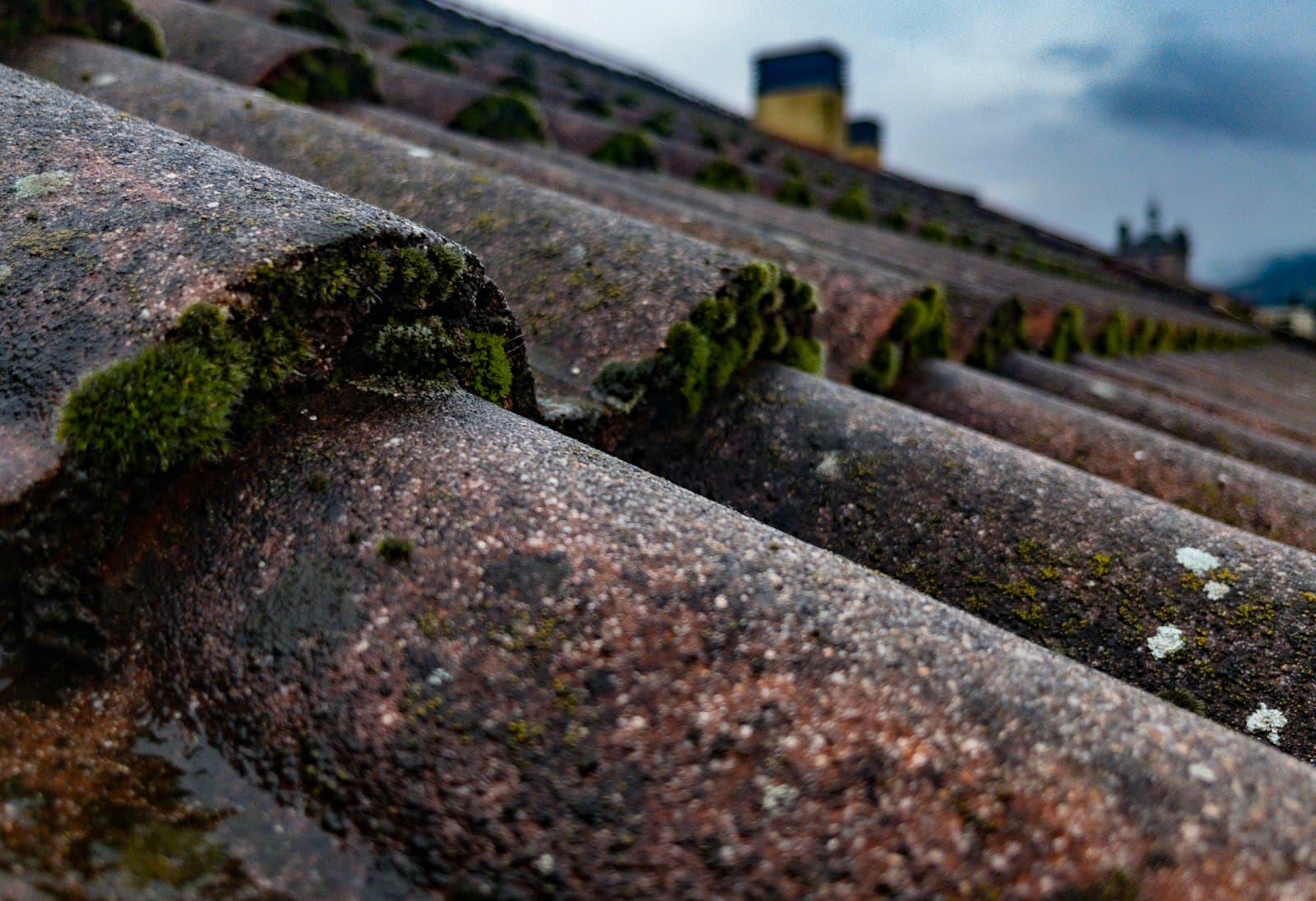
Roofing lead generation in Seattle is not a storm business, and the biggest mistake imported operators make is running it like one. There is no hail season to wait for, no adjuster to meet, no claim to sell against. Demand here comes from age, moisture and moss, and almost every part of that demand touches an environmental rule before it touches a roof.
That is the actual constraint. In Seattle the regulated thing is what leaves the roof. The moss killer most roofing companies advertise is a pesticide under state law, the wash water it produces is a discharge under city code, and the roof area itself is the unit a public rebate program pays on. Meanwhile the residential re-roof you are trying to sell needs no permit at all, which quietly removes two tactics the national roofing playbook depends on.
Why is roofing lead generation different in Seattle than in a storm market?
Because there is no event to sell against, so the offer has to create its own urgency out of maintenance rather than damage.
In a hail market the sequence is simple. Storm lands, claim opens, roofer arrives, insurer funds the job. Seattle has none of that. The roof degrades slowly under continuous biological load, the homeowner has no deadline, and there is no third party writing a cheque. That changes what a lead is. A Seattle roofing lead is almost always someone deciding whether to spend their own money on a roof that is not leaking yet.
The near term revenue in that market is moss and cleaning work, which is why so much of the local advertising leads with it. A homeowner in r/SeattleWA asking about light moss on a small, shallow pitched roof reported a single quote of $850 and thought it was high, which tells you both that the service sells and that it is priced without any shared reference point. That is a good business. It is also the most heavily regulated thing a Seattle roofer does, and almost nobody's marketing reflects that.
Do you need a license to treat roof moss in Seattle?
If you are applying a product for money, yes, and it is not a roofing registration.
Washington's Pesticide Application Act does the work here. RCW 17.21.020 defines a commercial pesticide applicator as any person who engages in the business of applying pesticides to the land of another, and defines a pesticide as any substance or mixture of substances intended to prevent, destroy, control, repel or mitigate any pest. A zinc sulfate moss killer applied to a customer's roof for compensation fits both halves of that with no interpretation required.
The Washington State Department of Agriculture runs the licence. To hold a commercial applicator licence you have to pass the Laws and Safety exam plus category exams for every area the business operates in, pay a $250 application fee, and file proof of financial responsibility under RCW 17.21.160 and 17.21.170. That proof is either a liability policy carrying $50,000 public liability and $50,000 property damage with a deductible no higher than $5,000, or a surety bond of at least $100,000. The licence renews annually, sits on a five year recertification cycle, and any change to the business has to be reported within 30 days. Separately, under RCW 17.21.110 an employee who actually applies the product needs a commercial pesticide operator licence, which carries its own $78 fee.
WSDA publishes a public licence search, so this is verifiable by a homeowner in about twenty seconds.
| Service you advertise | Licence needed beyond L&I registration | Why |
|---|---|---|
| Manual moss removal, brushing and scraping | None | No pesticide is applied |
| Zinc or chemical moss treatment | WSDA commercial applicator | Product meets the RCW 17.21.020 pesticide definition |
| Employee applying the product on site | WSDA commercial operator | Required separately by RCW 17.21.110 |
| Installing zinc or copper strips | None | Hardware, not an application |
| Roof washing with detergent | None for the soap, but see discharge rules below | Regulated as a discharge rather than a pesticide |
| Gutter cleaning and debris removal | None | No product, no discharge if bagged |
Read that table as a lead generation asset rather than a compliance chore. Almost every Seattle roofing site advertises moss treatment. A small minority can point at a WSDA licence number next to the offer. That is a differentiator nobody has to take your word for.
By the numbers
Washington's Department of Ecology studied a 7.2 square mile section of Lacey as a stand in for the Puget Sound region and estimated that 800 pounds of copper and 5,900 pounds of zinc are released each year from the materials it reviewed. In Ecology's own summary of where the zinc comes from, moss control is the biggest slice of the pie, ahead of siding, car tires and parking lots.
What happens to the water when you wash a Seattle roof?
It becomes a regulated discharge the moment it leaves the roof, and the city treats that as the contractor's problem.
Seattle Public Utilities is explicit that Seattle Municipal Code 22.803.030 requires all Seattle businesses to implement seven basic best management practices regardless of whether an inspection ever takes place. The first of the seven is eliminating non-stormwater discharges into the storm drain system. Enforcement is progressive rather than instant: SPU issues a corrective action letter giving the property or business owner 30 days to implement the required practices, then a notice of violation with a monetary penalty if they still are not in place.
The chemistry behind the rule is the part worth putting in front of a Seattle homeowner. Ecology's guidance on copper and zinc notes that copper reduces the ability of salmon to detect predators, and that zinc is likewise toxic to fish and plants, which is exactly why it clears moss off a roof. Ecology also names roofing, gutters, siding, chain link fencing and streetlights as the five sources it flagged for closer runoff monitoring.
There is a second layer on older buildings. SPU states that between 1929 and 1979 PCBs were added to a range of exterior building materials including roofing, and that the City has updated the Stormwater Code and Manual so that certain buildings must be assessed for the presence of PCBs on exterior materials before cleaning, maintenance, demolition or renovation can take place. Ecology's focus sheet on the same subject is direct about method, instructing that PCB containing materials should not be pressure washed. The 2026 Seattle Stormwater Code and Manual took effect on July 1, 2026, so this is current rather than historical.
For lead generation the implication is a qualifying question, not a paragraph of policy. Year built and building class decide whether a cleaning or tear off job carries an assessment step, and therefore whether your quote is even in the same units as the cheap one the homeowner is comparing it to.
Watch out
If your Seattle roof cleaning crew is rinsing product into the gutter and out to the street, the discharge is the violation, not the product. SMC 22.803.030 applies to the business performing the work, so the notice of violation lands on the contractor rather than the homeowner.
Do you need a permit to replace a roof in Seattle?
Usually not on a house, and that single fact breaks two standard roofing lead generation tactics.
Seattle SDCI states that a permit is not required for re-roof work at one and two family homes and townhouses if no changes are made to the building envelope other than adding or replacing insulation, and the insulation value is equivalent to or better than the existing structure. You do need a re-roof permit when you are replacing the roof cover, sheathing or insulation on commercial or multifamily projects, or when repairing an area greater than 500 square feet on those buildings. The stated purpose of the permit is energy code verification, and SDCI notes you need to add insulation to meet current standards when existing sheathing or insulation is exposed or the cavities are uninsulated.
The mechanics are fast. SDCI issues re-roofing permits the same day you apply online through the Seattle Services Portal, charges a flat fee of half the base fee plus the state surcharge and a technology fee, and requires no on-site inspection. You close the permit by emailing a completed Roof Replacement Affidavit.
Two consequences for anyone building a Seattle pipeline.
- There is no residential permit list to buy or scrape. The permit data mining tactic that works in cities requiring a re-roof permit on every house simply has no dataset here.
- "We pull a permit on every job" is not a trust signal in Seattle residential. On a like for like shingle replacement there is nothing to pull, so the claim reads as either uninformed or padded.
The inverse is the opportunity. Commercial and multifamily re-roofs are the permit bearing segment, they carry an energy code insulation obligation most residential specialists never price, and the buyer is a property manager or HOA board rather than a homeowner. If you are weighing how much of your budget should chase that, the arithmetic in how much roofing leads cost applies with a very different close rate.
If your Seattle roofing site is generating moss and cleaning enquiries you cannot legally fulfil, or re-roof enquiries you cannot price against a cash buyer, the fix is in the offer and the qualifying step rather than the ad spend. We build the conversion page, the qualifying form that arrives with the answers attached, and lead to sale tracking, then run campaigns into it.
What trust signals actually work in a state that does not license roofers?
The ones a homeowner can verify in a public database, because Washington gives them an unusually good one and actively tells them to use it.
Start with the vocabulary, because getting it wrong is itself a signal. Washington does not license construction contractors, it registers them. Labor and Industries regulates 63 specialties under WAC 296-200A-016, roofing among them, and a specialty contractor can only perform work in the specialty it is registered in and cannot hire subcontractors. Registration requires a surety bond of $15,000 for a specialty contractor or $30,000 for a general contractor, amounts that rose on July 1, 2024, plus liability coverage of $200,000 public liability and $50,000 property damage or a $250,000 combined single limit, and a $150.20 application fee. Everything about a registered contractor, including bond lawsuits and safety citations, sits in the public Verify a Contractor tool.
Then the advertising rules, which are stricter than most operators realise and cut directly against the default roofing headline.
| What the ad says | Status in Washington | Why |
|---|---|---|
| "Licensed, bonded and insured" | Prohibited in part | RCW 18.27.100(4) bars advertising that you are bonded and insured on the strength of the required bond and insurance |
| "Licensed roofing contractor" | Inaccurate | Washington registers contractors, it does not license them for roofing |
| A landing page with no registration number | Non compliant | RCW 18.27.100(3)(a) requires the current registration number on all advertising showing your name or address |
| A truck wrap with no registration number | Permitted under this subsection | Signs on motor vehicles are expressly carved out of the same provision |
| A door hanger with no registration number | Non compliant | Materials used to directly solicit retail customers must carry the number |
| "Registered with L&I, number XXXXX, verify us at the state site" | Permitted and rare | Verifiable, and invites the check most competitors avoid |
| A WSDA commercial applicator number next to a moss offer | Permitted and very rare | Directly answers the licensing question the service raises |
A finding of violation under RCW 18.27.100 can carry a penalty of up to $10,000 under subsection (8)(a), though the statute exempts violations determined to be inadvertent errors. The more useful point is competitive rather than punitive. This is the part of lead generation for local service businesses where the conversion page and the compliance read are the same afternoon of work. When one company's site says licensed, bonded and insured and the next one says registered with L&I under this number, applicator licensed under this number, verify both here, the second one is making a claim the homeowner can settle instantly.
That matters more here than in most markets because Seattle homeowners have been primed by local horror stories. An r/Seattle post from September 2025 described an elderly neighbour who took a door knock from a company claiming to be doing roofing work in the neighbourhood, paid $22,000 up front, had his shingles torn off the next day, and was then asked for tens of thousands more while the roof sat under tarps for over five weeks. Threads like that are why the verification path converts.
Two more items belong in the contract pack rather than the ad. RCW 18.27.114 requires the Notice to Customer disclosure statement, in twelve point and bold where appropriate, before starting any residential job of $1,000 or more, and subsection (4) bars a contractor from bringing a lien claim without proving it was given. It is cheap to do and expensive to skip.
Why is the three story townhome the most underserved roof in Seattle?
Because the city built an enormous number of them and most roofing companies will not bid one.
The demand side is a matter of record. Seattle's Office of Planning and Community Development reports that townhouses have been the most popular mid density housing type of the past decade and now make up roughly 40 percent of all new units built in lowrise zones, with almost 80 percent of new multifamily zone housing built in lowrise zones. That is a large, young, geographically concentrated stock of tall, steep, narrow roofs.
The supply side is the interesting half. A homeowner posting in r/SeattleWA described calling about a dozen Seattle area roofers for a three row, three story townhome and finding that none of them would do three stories, with several saying the roof was too steep. Their frustration is the whole opportunity in one sentence, that the townhome is the typical Seattle townhome found all over the city, so the fact that there are no options is confusing rather than expected.
Washington's fall protection rules explain the reluctance. WAC 296-880-20005 requires fall arrest, fall restraint or positioning device systems whenever employees are exposed to fall hazards of four feet or more, which is well below the federal construction threshold. On roofs pitched steeper than four in twelve, safety monitor systems and warning line systems are prohibited outright, so the cheap compliance options are off the table and the crew has to be tied off properly. Add a third storey and the liability insurance conversation gets its own line item.
That is a real cost, not a fake one. It is also a moat. A Seattle roofing company that invests in the anchor systems, the training and the insurance to quote three story steep pitch townhomes is competing against a nearly empty field in the fastest growing housing typology in the city, and can say so on a landing page that no competitor can copy without spending the same money.
How does RainWise change what a Seattle roofer can sell?
It turns roof area, the number you already measure, into a rebate the city pays for.
RainWise is a partnership between the King County Wastewater Treatment Division and Seattle Public Utilities. It pays rebates covering up to 100 percent of the cost of building rain gardens and cisterns on eligible properties inside combined sewer overflow basins, because keeping roof runoff out of a combined sewer is cheaper than treating the overflow. The average rebate is approximately $4,740. Over 2,600 Seattle property owners have used it, together managing the rain falling on the equivalent of 58 football fields and keeping more than 37 million gallons out of the sewer system every year. The program also explicitly courts large roofs, encouraging community centres, religious organisations, apartment buildings and businesses to take part, since a bigger roof means a bigger rebate.
Two operational details decide whether this is useful to you. The work has to be done by a RainWise trained contractor, and homeowners are required to maintain the installation for five years. So this is a partnership or a training investment, not a bolt on.
The lead generation value is the sequence. Eligibility is by address and combined sewer basin, so it is a genuinely geographic offer rather than a generic one. Pairing a free roof assessment with a RainWise eligibility check gives you a reason to be on the property, a number the homeowner cares about, and a five year maintenance relationship, all in a market where the standard roofing offer has no urgency attached. Most Seattle roofers have never mentioned it. For the broader argument about building offers instead of buying names, see roofing lead generation without buying leads.
How should a Seattle roofing quote be presented?
With the sales tax itemised, because Washington taxes the labour and the state presumes your number excludes it.
This is the quietest deal killer in the market. The Department of Revenue requires prime contractors to collect retail sales tax from the landowner on the gross contract price without deduction of costs incurred, which means labour, permits, profit, materials and subcontractors are all inside the taxable base. Retail construction services are sourced to where the construction happens, so a job in Seattle is taxed at Seattle's rate under location code 1726. For Quarter 3 of 2026 that combined rate is 10.55 percent, being 6.5 percent state and 4.05 percent local.
Revenue is equally firm on presentation. Under RCW 82.08.050 the department presumes a selling price quoted in any agreement does not include retail sales tax unless the tax is separately itemised, and states directly that the words tax included are not sufficient. Billing invoices must separately state it, and where a contract requires retainage the tax is computed before retainage is deducted.
| Quote as written | What the homeowner reads | What they actually pay |
|---|---|---|
| "$20,000 for a complete tear off and re-roof" | $20,000 | $22,110 |
| "$20,000 including all taxes" | $20,000 | $22,110, and the contractor eats the difference or renegotiates |
| "$20,000 plus Seattle retail sales tax at 10.55 percent, $2,110. Total $22,110" | $22,110 | $22,110 |
The third row closes better than the first, which is counterintuitive until you watch it happen. The homeowner collecting three bids is going to discover the tax on at least one of them, and the company that disclosed it up front becomes the honest one by comparison. Quoting a bare number and revealing two thousand dollars at signing is how you lose a job you already won, and it is a recurring cause of the pattern described in why roofing leads are not converting.
Where should a Seattle roofing company actually spend?
Against the constraints above, the channels sort differently here than in a storm market.
| Channel | Seattle fit | Main constraint |
|---|---|---|
| Google Search, moss and roof cleaning terms | Strong, steady, year round | Offer must be fulfillable, so WSDA licence or a manual only scope |
| Google Search, re-roof and roof replacement terms | Steady, no seasonal spike | No claim to sell against, so the price story has to carry it |
| Commercial and multifamily re-roof outreach | Under contested | Energy code insulation obligation must be priced in |
| Three story townhome and steep pitch positioning | Nearly uncontested | Requires real fall protection investment under WAC 296-880 |
| RainWise partnership or training | Uncontested by roofers | Trained contractor requirement, CSO basin eligibility only |
| Local Services Ads | Useful | Adds a background check signal the state registration does not convey on its own |
| Door knocking | Legal, reputationally expensive | Local scam threads have poisoned the channel in Seattle |
| Purchased shared leads | Weakest | You inherit someone else's compliance posture and copy |
| Permit data mining | Not available residentially | Seattle exempts like for like house re-roofs from permitting |
| Referral and past customer reactivation | Strongest return per dollar | Needs a system that stores roof age, moss history and building class |
Speed still decides more deals than anything on that table. A Seattle homeowner posting in r/Seattle in September 2025 about getting quotes reported that half the contractors never even showed up for the initial consultation, and that the ones who did were either overpriced or gave bad vibes. In a market with no storm urgency, the company that answers, arrives and documents is competing against a field that frequently does neither. That is a systems problem rather than a marketing one, and it is covered further in the best lead sources for roofing companies.
If you are also considering separate pages for Ballard, West Seattle, Shoreline and the rest, read should I build service area pages first. Thin near duplicate city pages remain a liability regardless of how big the metro is.
The Seattle roofing lead generation checklist
- Decide whether you are applying moss products for money. If yes, get the WSDA commercial applicator licence and put the number next to the offer. If no, advertise manual removal and say so plainly.
- Put your L&I contractor registration number on the website, every ad, every estimate and every door hanger. RCW 18.27.100(3)(a) requires it there.
- Delete "licensed, bonded and insured" from every asset. RCW 18.27.100(4) prohibits the bonded and insured half and Washington does not license roofers.
- Replace it with a verification invitation pointing at the L&I Verify tool and, where relevant, the WSDA licence search.
- Write a roof wash water plan that keeps the discharge out of the storm drain, and train the crew on it. SMC 22.803.030 applies whether or not you are ever inspected.
- Add year built and building class to the qualifying form, so pre 1980 commercial and multifamily jobs get priced with the PCB assessment step included.
- Stop advertising that you pull permits on residential re-roofs. Advertise it on the commercial and multifamily work where Seattle actually requires one.
- Build a separate offer for three story and steep pitch townhomes, and fund the fall protection that makes it real.
- Itemise Seattle retail sales tax at 10.55 percent on every quote, and never write tax included.
- Get RainWise trained or partner with someone who is, then pair the eligibility check with your free roof assessment.
- Attach the RCW 18.27.114 Notice to Customer to every residential job of $1,000 or more, and keep the signed copy for three years.
- Track lead to signed contract to installed job in one system, so the next time a quarter goes soft you can tell a copy problem from a capture problem.